CNC Milling Services.
Xofah integrates seamlessly with over 10,000 qualified manufacturing partners, including US-based ITAR qualified and AS9100D registered CNC milling facilities. We support 3-axis, 4-axis, 5-axis milling, and right angle milling capabilities to help you rapidly create designs from simple straight lines to complex geometric shapes.
3-Axis Milling
Standard vertical and horizontal milling for most part geometries.
4-Axis Milling
Rotary axis milling for cylindrical features and reduced setups.
5-Axis Milling
Simultaneous 5-axis machining for the most complex parts.
High Quality Rapid CNC Milling Service
Xofah integrates seamlessly with over 10,000 qualified manufacturing partners, including US-based ITAR qualified and AS9100D registered CNC milling facilities. That massive network means that whatever your part, we have a shop and a machine that can make it.
We support 3-axis, 4-axis, 5-axis milling, and right angle milling capabilities to help you rapidly create designs from simple straight lines to complex geometric shapes.
Xofah offers instant pricing, on-demand lead times, and design-for-manufacturability feedback on materials and manufacturing processes for your custom CNC milled parts, no matter your industry. Get your instant quote today.
High Precision
Tolerances as tight as ±0.001" (±0.025mm)
Large Parts
Mill parts up to 80" x 48" x 24"
40+ Materials
Metals, plastics, and composites
Fast Delivery
Parts in as fast as 1-3 days
Operational Logic
Materials Available at Xofah
A variety of custom CNC milled parts, including metal and plastic, options are available for an instant online quote. If you do not see the material stock you are looking for, please choose 'Other' under the material drop-down on your quote page and submit for an expert engineering review once you have specified features, tolerances, inspection needs, and quantities required.
Custom Sourced Materials
Additional alloys and tempers are available upon request. We can source to your project specifications. If you do not see your alloy or material listed on our platform, please select 'Other' and write in that specific material.
| Aluminum | Bronze/Brass | Copper | Plastics | Steel / Titanium / Zinc |
|---|---|---|---|---|
| Aluminum 5052 | Brass C360 | EPT Copper C110 | ABS | Alloy Steel 4130, 4140 |
| Aluminum 7075 & 7075-T6 | Brass 260 | Copper 101 | Acetal [Delrin] | ASTM A36 |
| Aluminum 6063-T5 | C932 M07 Bearing Bronze | Acrylic | Stainless Steel 15-5, 17-4, 18-8, 303 | |
| Aluminum 7050-T7451 | G-10 Garolite | Stainless Steel 303, 304, 316/316L | ||
| Aluminum MIC-6 | Nylon 6/6 | Stainless Steel 416, 420 | ||
| Aluminum 6061-T6 | PEEK | Steel, Low Carbon | ||
| Aluminum 2024-T3 | Polycarbonate | Steel A36 | ||
| PTFE [Teflon] | Titanium Grade 2, Titanium 6Al-4V, Zinc Sheet Alloy 500 | |||
| Polypropylene | ||||
| Ultra-High Molecular Weight Polyethylene |
Available Finishes
Choose from a variety of finishing options to meet your aesthetic and functional requirements.
As-Milled
The finish option with the quickest turnaround. Parts are left with visible tool marks and potentially sharp edges and burrs, which can be removed upon request. Surface finish is comparable to 125 uin Ra finish.
Bead Blast
The part surface is media blasted, typically using glass bead, to produce a smooth, matte appearance.
Anodized (Type II Or Type III)
Type II creates a corrosion-resistant finish. Parts can be anodized in different colors—clear, black, red, and gold are most common—and is usually associated with aluminum. Type III is thicker and creates a wear-resistant layer in addition to the corrosion resistance seen with Type II.
Powder Coat
This is a process where powdered paint is sprayed onto a part which is then baked in an oven. This creates a strong, wear- and corrosion-resistant layer that is more durable than standard painting methods. A wide variety of colors are available to create the desired aesthetic.
Custom
Don't see the finish you need? Submit an RFQ and we'll look into a finishing process for you.
CNC Milling Tolerances & Standards
Xofah can manufacture and inspect to tight tolerances, including sub ±0.001" tolerances, per your drawing specifications and GD&T callouts.
| Description | General Tolerance or Standard |
|---|---|
| Maximum Part Size | Milled parts up to 80" x 48" x 24" (2,032 x 1,219 x 610 mm) |
| Distance Dimensions | For features of size (Length, width, height, diameter) and location (position, concentricity, symmetry) +/- 0.005" |
| Orientation and Form Dimensions | 0-12" +/- 0.005", Angularity 1/2 degree. For 24" and beyond please consult Xofah's Manufacturing Standards |
| Precision Tolerances | Xofah can manufacture and inspect to tight tolerances, including sub +/- 0.001" tolerances, per your drawing specifications and GD&T callouts |
| Minimum Feature Size | 0.020" (0.50 mm). This may vary depending on part geometry and chosen material |
| Threads and Tapped Holes | Xofah can accommodate any standard thread size. We can also machine custom threads; these will require a manual quote review |
| Surface Finish | The standard finish is as-machined: 125 Ra or better. Additional finishing options can be specified when getting a quote |
| Edge Condition | Sharp edges will be broken and deburred by default. Critical edges that must be left sharp should be noted and specified on a print |
Overview: What is CNC Milling?
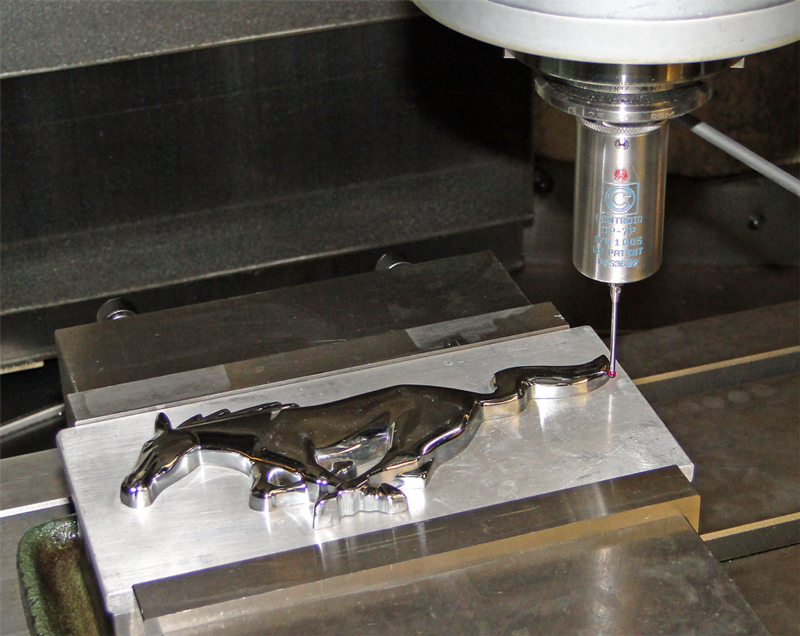
CNC mills are automated cutting machines using a rotating spindle-head to cut away unwanted material. CNC milling machines come in a variety of sizes and different axis configurations. This manufacturing process is mainly utilized to cut harder metals but can work with workpiece materials ranging from plastic and aluminum to stainless steel and titanium.
The Basics Of CNC Mills
CNC mills are automated cutting machines using a rotating spindle-head to cut away unwanted material. CNC milling machines come in a variety of sizes and different axis configurations. This manufacturing process is mainly utilized to cut harder metals but can work with workpiece materials ranging from plastic and aluminum to stainless steel and titanium.
How CNC Milling Works
CNC mills excel at profile cutting harder materials. Like all CNC machines, a CNC mill is controlled with G-Code created through CAM software. The G-Code instructs the machine where to move the tool head, how fast to spin the tool, how deep to cut, how to move the workpiece, and other factors relating to speed, feed rate, and coordination. The G-Code complexity depends on how many axes the milling machine has.
Mills can still be used for profile cutting of softer materials, but are not as cost-effective for that use as CNC routers. The main difference between these machines is that with a CNC router the workpiece remains stationary while the router cutting head is directed around the piece, while a CNC mill may move both tool head and workpiece. CNC mills are mainly used in industrial manufacturing, while CNC routing is more common for lower output manufacturing like woodworking.
Types of CNC Mills
3-Axis
The most widely used type of CNC milling machine. The full use of the X, Y, and Z directions makes a 3 Axis CNC mill useful for a wide variety of work.
4-Axis
This type of router allows the machine to rotate on a vertical axis, moving the workpiece to introduce more continuous machining.
5-Axis
These machines have three traditional axes as well as two additional rotary axes. A 5-axis CNC router is, therefore, able to machine 5 sides of a workpiece in one machine without having to remove the workpiece and reset. The workpiece rotates, and the spindle head is able to also move around the piece. These are larger and more expensive.
Other Benefits Of CNC Mill Machining Processes
CNC milling machines are built for precise manufacturing and repeatability which makes them perfect for rapid prototyping and low-to-high volume production runs. CNC mills can also work with a variety of materials from basic aluminum and plastics to more exotic ones like titanium — making them the ideal machine for almost any job.
3-Axis CNC Milling Details
3-axis milling is the most common and cost-effective CNC milling process. The cutting tool moves along three linear axes (X, Y, Z) to remove material and create the desired shape.
Best For
Vertical Machining Centers (VMC)
Spindle oriented vertically, ideal for flat parts and pockets
Horizontal Machining Centers (HMC)
Spindle oriented horizontally, better chip evacuation for deep pockets
Cost-Effective
Lower machine rates compared to 4 and 5-axis milling
Wide Availability
Most common type of CNC machine, readily available
4-Axis CNC Milling
4-axis milling adds a rotary axis (A-axis) to the standard 3-axis setup, allowing the part to rotate during machining. This enables machining of cylindrical features and reduces the number of setups required.
Best For
Continuous Rotation
Machine cylindrical and curved surfaces in one setup
Reduced Setups
Machine multiple sides without repositioning the part
Better Accuracy
Fewer setups mean better dimensional accuracy
Complex Contours
Create complex 3D contours and helical features
5-Axis CNC Milling
5-axis milling adds two rotary axes (A and B, or A and C) to the standard 3-axis setup, allowing the cutting tool to approach the workpiece from any direction. This enables machining of the most complex geometries in a single setup.
Best For
Complex Geometries
Machine parts with undercuts, deep cavities, and complex contours
Single Setup
Complete parts in one setup for maximum accuracy
Superior Surface Finish
Optimal tool orientation for better surface finish
Shorter Tools
Use shorter, more rigid tools for better accuracy
CNC Milling Capabilities
| Specification | 3-Axis | 4-Axis | 5-Axis |
|---|---|---|---|
| Maximum Part Size | 80" x 48" x 24" | 60" x 36" x 20" | 40" x 30" x 20" |
| Minimum Feature Size | 0.010" | 0.010" | 0.008" |
| Standard Tolerance | ±0.005" | ±0.005" | ±0.003" |
| Tight Tolerance | ±0.001" | ±0.001" | ±0.0005" |
| Surface Finish | Ra 125 µin | Ra 63 µin | Ra 32 µin |
| Typical Lead Time | 3-5 days | 5-7 days | 7-10 days |
| Relative Cost | $ | $$ | $$$ |
Milling Materials
Metals
Plastics
Applications
Advantages of CNC Milling
Versatility
Mill a wide range of materials and part geometries
Precision
Achieve tight tolerances and excellent surface finish
Efficiency
High material removal rates for faster production
Repeatability
Consistent quality across production runs
Complex Features
Create pockets, holes, contours, and 3D surfaces
No Tooling
No molds or dies required, ideal for prototypes
Get Started with CNC Milling
Upload your CAD files for instant pricing and DFM feedback.